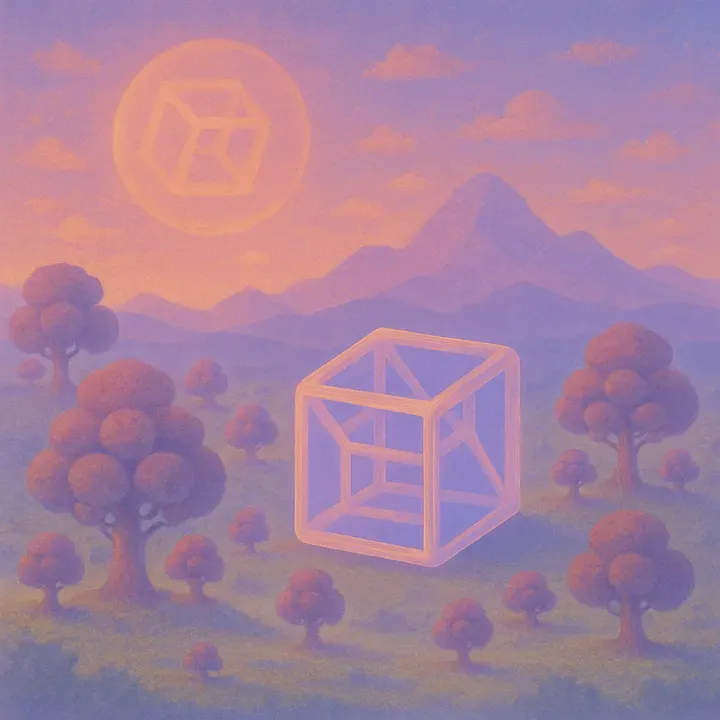
Starting a game in 4D means rethinking every single aspect of game development through a completely new1 lens. Most crucially, no game engine (that I know of) natively supports the features I need. Unity? Unreal? They’re built for our 3D world and stop there.
No Roads Lead to 4D
So before I could build a game, I had to build the foundation itself. First order of business: render our first hypercube!
But to understand how the screenshot you’ll see came to be — and how to read it the right way — we need to break down the principles of projecting 4D down to 2D.
The Foundation: How 3D Becomes 2D
Imagine you’re looking through a window at the world outside. That window is your computer screen. To figure out where each 3D point should appear on the screen, we draw a straight line from your eye through the 3D point until it hits the window. Where it hits the window is where we draw that point on screen.
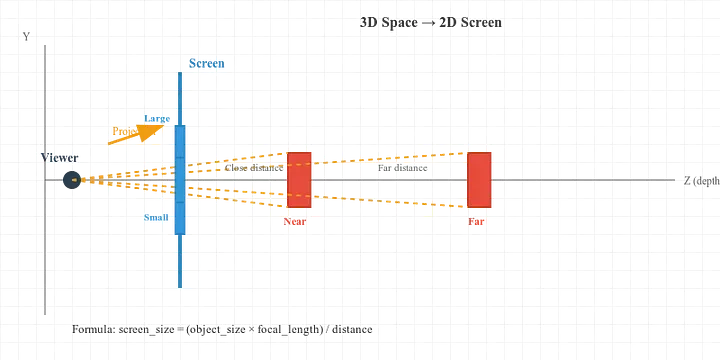
Some key insights that will become crucial for 4D:
- Objects further away appear smaller, because the projection rays converge as they get closer to your eye.
- What you are “looking at” sits at the center of the projection plane.
- When you turn your head to the left (assuming your screen turns with you), you see objects move in your field of view to the right.
- Objects further away in the same direction appear inside — or behind, if the front object is opaque.
- The “forward” axis disappears — it’s precisely the dimension along which things get projected.
The Leap: 4D on a 3D Surface
My first screenshot of a soon-to-be AAA game:
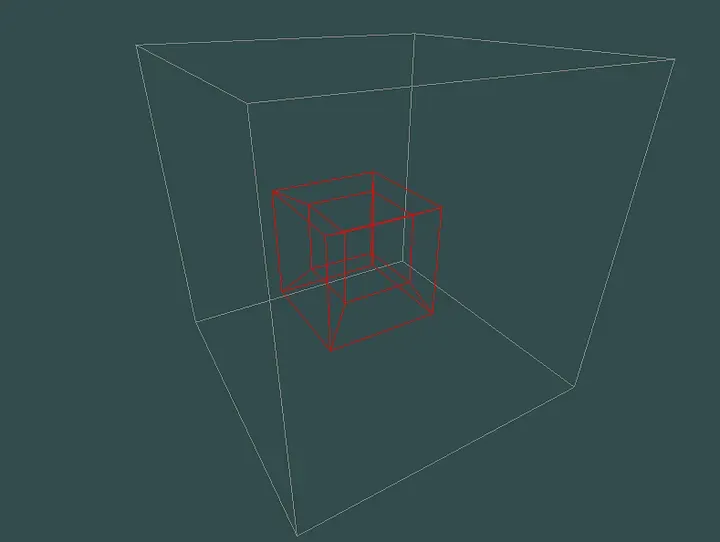
The principle is exactly the same. So how should you interpret that image?
First, you see a big grey cube. This is your screen — but not your computer screen. This grey cube is a 3D projection screen floating in space. It won’t move, and only what happens inside it is the actual game you’re interested in. Yes, it’s itself projected onto your 2D screen (because that’s the actual shape of your monitor), but try your best to visualize it “in 3D” — it will make understanding everything else infinitely easier.
Inside this 3D screen, you see a red shape that looks like one big cube containing one smaller cube.
Aha!
Ever noticed how a 3D cube, viewed from the right angle, looks like this in 2D projection?
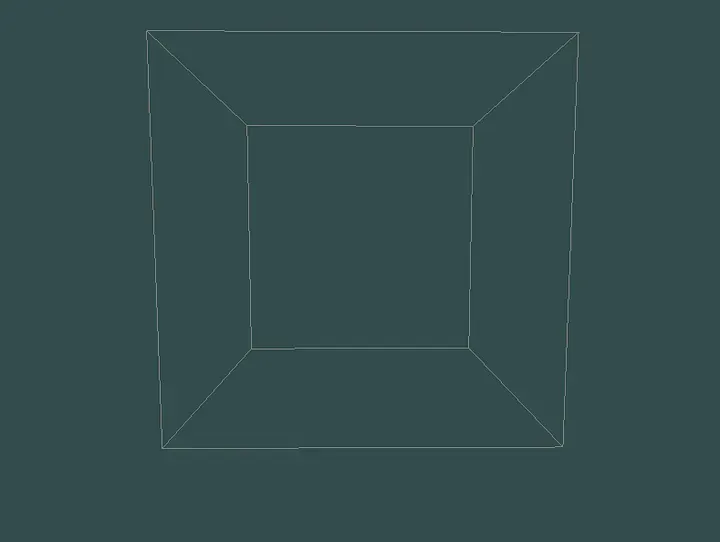
One big square containing one smaller square!
It’s the exact same phenomenon here. What we’re seeing in red are the front hyperface and the back hyperface of a hypercube. The “side hyperfaces” are being twisted and distorted the same way the sides of a 3D cube appear as trapezoids in 2D projection.
But here’s where it gets mind-bending: while a cube has 4 “side” faces, our hypercube has 6 “side” hyperfaces — one for each face of the inner and outer cubes you see!
This understanding is fundamental to what comes next: movement in our game.
Think about it: in a 3D game, you move forward/backward, left/right, up/down. In our 4D game, you move forward/backward, left/right, up/down, and ana/kata — the fourth-dimensional directions.
But how do you show a player they’re moving in a direction that doesn’t exist in their visual experience? How do you design UI for navigation in impossible space? How do you make it intuitive when the geometry itself defies intuition?
Let’s tackle those questions in a next post, one hypercube at a time.
What’s Next
In the coming devlogs, we’ll dive deep into:
- Movement mechanics: how to walk through 4D space without losing your mind.
- Rendering techniques: how to get rid of wireframe rendering — and maybe into something volumetric?
- Rotations: getting a torticollis in 4D is on a whole other level.
- 4D level design: creating spaces that are impossible yet intuitive.
Footnotes
-
While there have been some attempts at making 4D games, most fall short of what I want to achieve. Two are worth mentioning. Miegakure is inspiring and astoundingly well polished, but takes a stance on 4D that’s unconvincing to me: accepting that we’ll only ever be able to see a slice of it. The other is the 4D Maze Game, which is much closer to my vision and really got me into 4D — but it requires looking through crossed-eyes 3D… not for everyone. ↩