
What Are the Four Dimensions in Our Game?
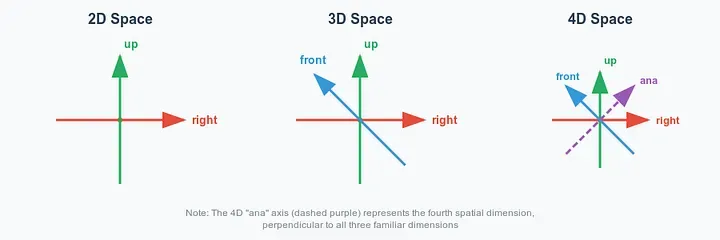
In my game, we’re building a world with four genuine spatial dimensions. Like many 3D games, we’ll have one “special” dimension with two directions — up and down — with constant gravity pulling everything downward.
Among the three remaining dimensions, two will sound familiar. But here’s the crucial point: all three must be understood as completely symmetrical. None is more important or more “intuitive” than the others. As a matter of fact, we’ll most often take the point of view of a character standing upright, so those three directions are relative to that character. This means they can change and switch — the same way your left becomes your back when you turn right.
The four directions are:
- Left and right
- Front and back
- Ana and kata (as is customary in 4D terminology)
Mind-Bending Fun Facts from the 4D World
Before we delve into specific intuition, insights, or mathematical details, here’s a collection of fun facts and surprisingly visualizable phenomena — an introduction to the wonders of our 4D world.
The Hypercube: A Cube’s Four-Dimensional Cousin
In four dimensions, the equivalent of a cube is called a hypercube. Here’s how geometric complexity explodes as we add dimensions:
- A line has 2 vertices.
- A square has 4 vertices and 4 edges.
- A cube has 8 vertices, 12 edges and 6 squares.
- A hypercube has 16 vertices, 32 edges, 24 faces and… 8 cubes.
Go figure out what that looks like!
The Four-Legged Stool Test
In four dimensions, a stool needs four legs.
Want to know how many dimensions the world you’re in has? Try building a stool! In our world, three legs leave it nowhere to lose balance. In a four-dimensional world, it needs a fourth leg!
The Impossible Knot Problem
In four dimensions, you cannot tie a knot.
Not in the usual sense, at least. In a 4D world, there’s no way to make a knot for your shoelaces, for instance. Pull on the end and it will simply undo itself!
The Inside-Out Football Trick
In four dimensions, you can turn a football inside out.
If your football is damaged, you just reverse it and tuck the exterior inside! Take your football — or any sphere — and just follow the instructions. That wasn’t difficult, was it?
The Sixth Platonic Solid
In four dimensions, there is one more Platonic solid.
The five Platonic solids — allegories of the beauty and purity of mathematical truth. While we have only five to contemplate in our 3D world, there are actually six in a four-dimensional one. And some of them are far prettier than ours!
Storage Space Paradise
In four dimensions, a hypercube of 1 m⁴ holds 10,000 hyper-litres of 10 cm⁴.
You can stuff so many more packs of oat milk in your drawer!